Water · Mutable · 330°–360°
Pisces Zodiac Sign: The Definitive Guide
A complete visual reference to Pisces dates, mutable-water structure, Jupiter and Neptune rulership, two-fish symbolism, constellation astronomy, relationships, work, boundaries, growth and birth-chart interpretation.
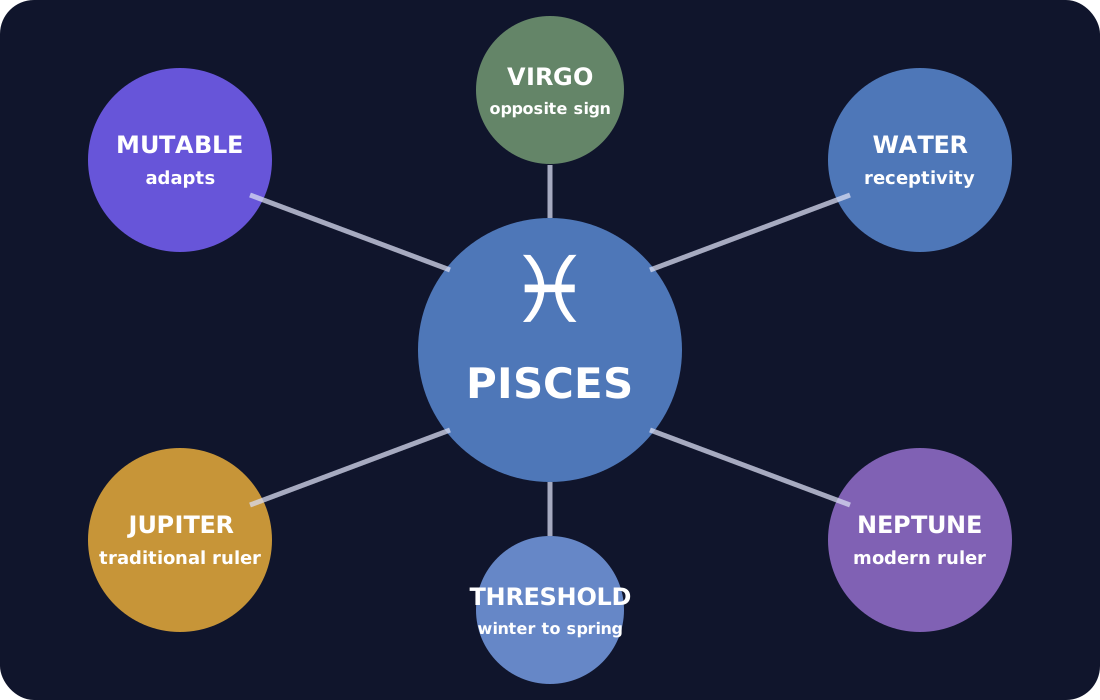
- Pisces is mutable water: receptivity and feeling combined with adaptation and transition.
- Jupiter is the traditional ruler; Neptune is the modern ruler in many contemporary systems.
- Pisces closes the tropical zodiac and prepares the transition back to Aries.
- Virgo is Pisces’ opposite sign, creating an axis of intuition and discrimination.
- The Pisces sign and Pisces constellation are different systems.
Pisces at a glance
| Standard tropical dates | February 19–March 20 |
|---|---|
| Zodiac position | 330°–360° |
| Element | Water |
| Modality | Mutable |
| Traditional ruler | Jupiter |
| Modern ruler | Neptune |
| Symbol | Two Fish |
| Opposite sign | Virgo |
| Seasonal position | Transition from northern winter toward spring |
What Pisces represents
Pisces represents receptivity, imagination, compassion, symbolic perception and the integration of experience at the end of a cycle. As the twelfth sign, it follows Aquarius’ concern with systems and collective principles and asks what remains when firm categories begin to dissolve.
The sign is often described as dreamy, but that label is too narrow. Pisces concerns the ability to perceive connections that are emotional, imaginative or difficult to measure directly. This can support art, caregiving, spirituality, storytelling and contextual intelligence. It can also make boundaries and prioritization more difficult when everything feels connected.
A Pisces placement does not make someone passive or irrational. It describes a style through which a planet or chart point may operate. The complete meaning depends on the planet, house, aspects and the rest of the chart.
The seasonal threshold and Pisces’ place in the cycle
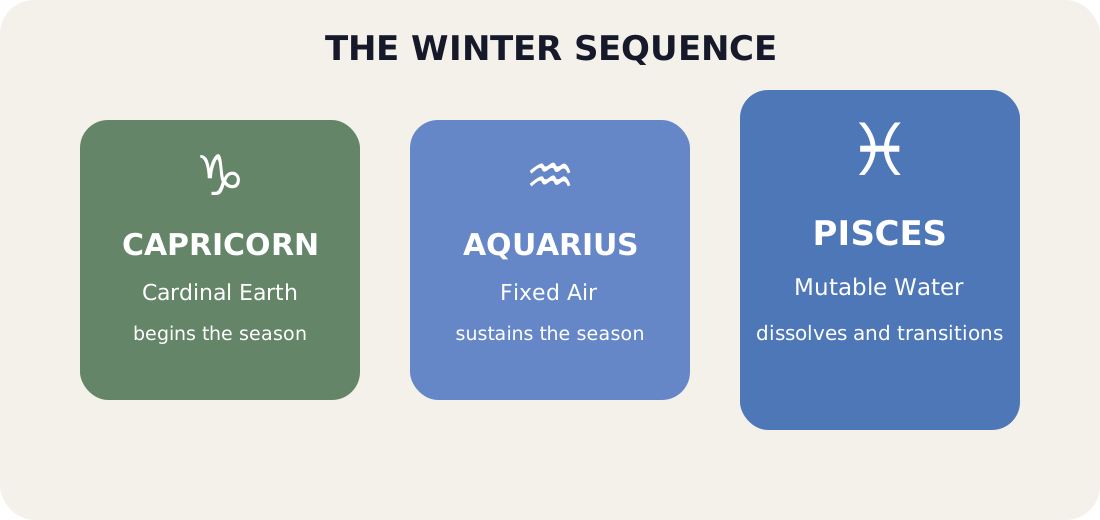
In the tropical zodiac, Pisces occupies the final part of northern-hemisphere winter. Capricorn begins the season, Aquarius sustains it and Pisces prepares the transition toward spring and Aries.
Mutable signs close seasons. Their symbolism emphasizes adaptation, distribution and preparation for change. Pisces applies that mutable quality to water: feelings, memory, empathy and subjective experience move across boundaries and search for a larger pattern.
The seasonal model explains Pisces’ themes of endings, release and transition. It is a symbolic structure anchored to the tropical zodiac, not a claim that climate determines personality.
History, mythology and the two fish
The image of fish in the zodiac has roots older than a single Greek story. Zodiac symbolism moved through ancient Mesopotamian, Egyptian and Greco-Roman cultures, changing as images and myths were translated into new religious and astronomical systems.
Classical versions commonly connect Pisces with Aphrodite and Eros escaping the monster Typhon by entering the water or being carried to safety by fish. The two fish are often shown joined by a cord, suggesting connection across different directions or realms.
The symbol can be read as a tension between separation and unity: two beings moving independently but remaining linked. Modern astrology frequently uses this image to discuss competing currents, empathy and the challenge of preserving identity while feeling connected to something larger.
Historical myths should not be treated as one fixed origin story. They are layers in a much longer process through which star patterns, calendars and cultural symbols were transmitted.
The Pisces constellation
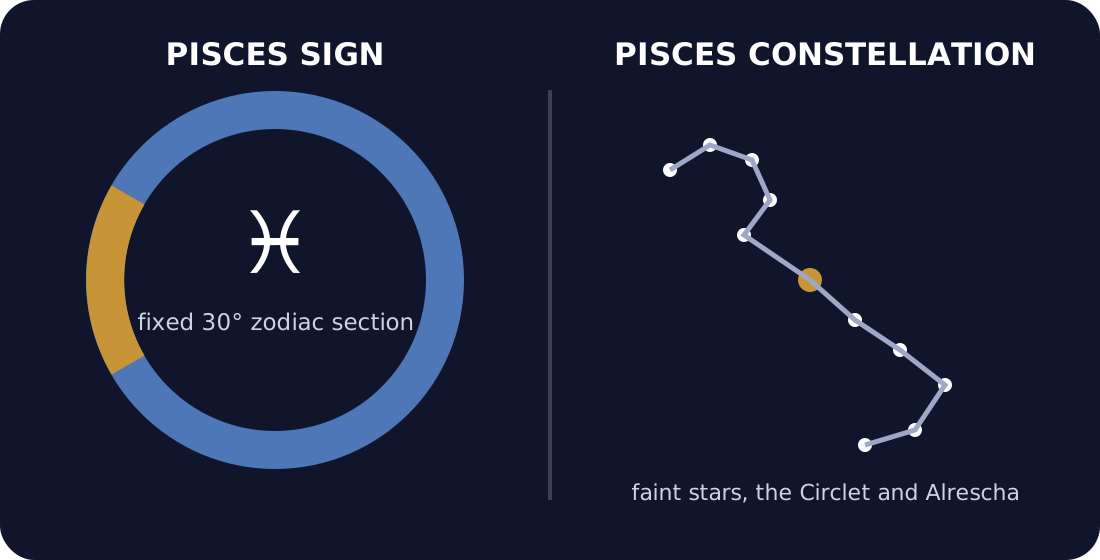
Pisces the sign is a fixed 30-degree section of a zodiac system. Pisces the constellation is an irregular region of the sky defined by astronomical boundaries. They share a name and history but are not the same category.
Pisces is a faint constellation, making it harder to identify than brighter zodiac constellations. One recognizable feature is the Circlet, a small ring-shaped asterism associated with the western fish. Alrescha, Alpha Piscium, is traditionally associated with the knot that joins the two fish.
For Northern Hemisphere observers, Pisces is generally better placed in autumn evening skies, even though tropical Pisces season occurs near the end of winter. This difference helps illustrate why a sign’s calendar season and a constellation’s best nighttime visibility are separate questions.
Constellation stars may appear to form a connected shape from Earth while lying at very different distances. The IAU defines constellations by bounded sky coordinates rather than by the connecting lines commonly drawn on star charts.
Mutable water, Jupiter and Neptune: the Pisces formula
Water
Water signs are associated with emotion, intuition, memory and bonding. Pisces water is especially permeable and associative, noticing mood, symbolism and the relationship between separate experiences.
Mutable modality
Mutable signs adapt and complete. In Pisces, this can appear as flexibility, empathy and the ability to move between viewpoints. The same adaptability can become avoidance, confusion or difficulty making a final commitment.
Jupiter
Jupiter is Pisces’ traditional ruler. Its symbolism of meaning, faith, generosity and expansion appears here through compassion, imagination and the search for an inclusive perspective.
Neptune
Neptune became Pisces’ modern ruler because modern astrology associates it with imagination, ideals, dissolution and sensitivity. Its astronomical identity as a planet is separate from those symbolic meanings.
Pisces personality and traits
Traditional strengths
- Empathy
- Imagination
- Adaptability
- Symbolic awareness
- Compassion
- Capacity to integrate experience
Common growth themes
- Clear boundaries
- Concrete follow-through
- Testing intuition against evidence
- Distinguishing compassion from self-erasure
- Ending cycles deliberately
- Choosing priorities
These themes are interpretive, not diagnostic. A strong Pisces emphasis can appear as artistic sensitivity, practical caregiving, spiritual inquiry, imaginative strategy or many other expressions.
Communication and decision-making
Pisces communication is traditionally described as intuitive, associative and responsive to tone. It may use images, stories, implication or emotional context rather than only linear argument.
This style can communicate nuance that more literal approaches miss. It can also create misunderstanding when assumptions remain unstated. Clear summaries and explicit agreements help translate intuition into shared understanding.
Decision-making
Pisces may keep multiple possibilities open because it can imagine how each choice affects everyone involved. A useful decision process separates empathy from obligation, names concrete criteria and sets a time for commitment.
Work, creativity and learning
Pisces is often associated with work involving imagination, care, music, film, design, healing, hospitality, advocacy or sensitivity to complex human contexts. This is not a deterministic career list; education, skills, opportunity and values matter far more than a Sun sign.
Creativity
Pisces creativity often begins with atmosphere, image or feeling. The challenge is building a container—schedule, craft, budget or deadline—that allows inspiration to become finished work.
Learning style
Pisces may learn effectively through narrative, analogy, visualization, immersion and emotional relevance. Checklists and repetition can support subjects requiring sequential precision.
Workplace challenges
Possible difficulties include unclear roles, overpromising from compassion, absorbing group stress or delaying direct conversations. Written expectations and protected recovery time can be especially helpful.
Love, boundaries and conflict
Pisces relationship symbolism emphasizes compassion, romance, emotional understanding and the desire for a bond that feels meaningful. It may perceive subtle changes in mood and respond before a need is spoken.
The central growth question is whether empathy remains mutual. Compassion without boundaries can become rescuing, idealization or silent resentment.
Conflict
Pisces may avoid harsh confrontation, merge with the other person’s perspective or retreat when feelings become overwhelming. Healthy conflict requires naming the issue directly while preserving kindness.
Boundaries
A boundary is not a rejection of connection. It gives connection a form. Pisces growth often involves saying what is possible, what is not possible and what belongs to another person to resolve.
Friendship and social patterns
Pisces is traditionally associated with acceptance, emotional availability and imagination in friendship. It may be especially present when a friend feels misunderstood or vulnerable.
A useful growth edge is distinguishing friendship from permanent emotional responsibility. Support becomes more sustainable when both people can ask, decline and recover.
Parenting and family themes
Pisces parenting symbolism includes sensitivity, comfort, imagination and helping children feel emotionally understood. It may encourage art, stories, compassion and rich inner life.
The challenge is maintaining structure when a child is distressed. Predictable routines and consistent consequences can coexist with tenderness and help a sensitive household feel safer.
Money, generosity and practical systems
Pisces symbolism may prioritize immediate human need, meaning or generosity over abstract financial rules. At its best this creates compassionate use of resources. Without structure it can lead to unclear lending, avoidance or spending that temporarily relieves emotion.
Useful practices include automatic savings, written agreements, a defined generosity budget and a pause before financial decisions made from guilt or idealization.
Pisces under stress and during growth
Under stress, Pisces can become overwhelmed, avoidant, overly idealistic or uncertain about which feelings belong to whom. It may seek relief by withdrawing into fantasy, distraction or endless possibility.
Growth practices
- Name one concrete next action.
- Use routines to protect sensitivity rather than suppress it.
- Check intuitive impressions against observable evidence.
- Distinguish helping from taking over.
- Complete endings instead of leaving every door partly open.
Pisces’ deeper growth is not becoming less sensitive. It is developing enough structure that sensitivity can become discernment, creativity and sustainable compassion.
Pisces in a birth chart
The planet describes the function, Pisces describes the style, the house describes the life area and aspects describe interaction.
| Placement | Traditional emphasis |
|---|---|
| Sun in Pisces | Identity shaped by imagination, receptivity, compassion and integration. |
| Moon in Pisces | Emotional sensitivity, empathy, imagery and porous boundaries. |
| Pisces rising | A receptive, adaptive approach; Jupiter and Neptune become important chart rulers. |
| Mercury in Pisces | Associative, intuitive and image-based thinking. |
| Venus in Pisces | Romantic imagination, compassion and idealization. |
| Mars in Pisces | Adaptive or inspired action guided by feeling and meaning. |
These are starting points, not complete readings. Houses, aspects and other placements can reinforce, redirect or complicate each interpretation.
The Pisces–Virgo polarity
Pisces and Virgo oppose one another and share the mutable modality. Pisces emphasizes integration, empathy and the whole. Virgo emphasizes discrimination, practical method and the part that needs attention.
The axis asks how to remain open without losing discernment, and how to improve reality without reducing life to a list of flaws. Healthy Pisces benefits from Virgo’s boundaries and method; healthy Virgo benefits from Pisces’ context and compassion.
Pisces myths versus facts
| Myth | More accurate explanation |
|---|---|
| All Pisces are confused. | Pisces symbolism is associative and receptive. Confusion is one possible imbalance, not an inevitable trait. |
| Pisces has no boundaries. | Boundaries are skills that vary among individuals and can be strengthened. |
| Pisces is the Pisces constellation. | The sign is an equal zodiac section; the constellation is an irregular sky region. |
| Pisces is ruled only by Neptune. | Jupiter is the traditional ruler; Neptune is the modern ruler used by many contemporary astrologers. |
| Pisces is weak. | Receptivity and compassion can require substantial resilience; behavior cannot be inferred from one sign. |
Frequently asked questions
What dates are Pisces?
The standard tropical date range is February 19 through March 20. Exact ingress times can shift slightly by year and time zone.
What element is Pisces?
Pisces is a water sign.
What modality is Pisces?
Pisces is a mutable sign.
What planets rule Pisces?
Jupiter is Pisces’ traditional ruler. Neptune is commonly used as its modern ruler.
What is Pisces’ symbol?
Pisces is symbolized by two fish, often shown connected by a cord.
What sign is opposite Pisces?
Virgo is opposite Pisces on the zodiac wheel.
What does mutable water mean?
Mutable water symbolizes emotional adaptability, receptivity, imagination and the ability to move between perspectives.
Why is Jupiter associated with Pisces?
Traditional astrology links Jupiter with meaning, faith, generosity and expansion. Pisces expresses those themes through empathy, imagination and openness.
Why is Neptune associated with Pisces?
Modern astrology associates Neptune with imagination, ideals, dissolution and sensitivity, themes that overlap with modern Pisces interpretation.
Is Pisces always emotional?
No. Pisces symbolism concerns receptivity and subjective awareness, but actual emotional expression depends on the whole chart and the person.
Is Pisces always artistic?
No. Imagination may appear through art, caregiving, strategy, spirituality, problem-solving or many other forms.
Is Pisces the same as the Pisces constellation?
No. Pisces the sign is an equal 30-degree zodiac section; Pisces the constellation is an irregular astronomical sky region.
Sources and further reading
- International Astronomical Union — The Constellations — official explanation of constellation boundaries.
- NASA — Plane of the Ecliptic — scientific context for the ecliptic.
- Starwatch — Pisces in the autumn sky — observing context, faint stars and the Circlet.
- Encyclopaedia Britannica (1911) — Pisces — historical reference to the two fish, mythology and Alrescha.
- Staatliche Museen zu Berlin — Destiny in the Stars — museum context for the ancient zodiac’s cultural transmission.
Editorial note: This page distinguishes astronomical facts and historical sources from astrological interpretation. Pisces meanings describe traditions and traditional astrological interpretations, not scientifically proven personality traits.