Start here
Learn Astrology in a Clear Order
You do not need to memorize hundreds of meanings at once. Start with the zodiac framework, then learn signs and planets, add houses and aspects, and only then read a birth chart as a whole.
Beginner path
Seven steps from the zodiac to a complete chart
You can use this page as a syllabus. Each step answers a different question, so there is less risk of mixing concepts together.
| Step | Learn | Question it answers | Start with |
|---|---|---|---|
| 1 | Zodiac framework | What system am I using? | Zodiac systems |
| 2 | Signs | How is a chart function expressed? | 12 zodiac signs |
| 3 | Elements + modalities | What family and operating style does a sign have? | Elements · Modalities |
| 4 | Planets | What function is active? | Planets |
| 5 | Houses | Where in life is it expressed? | 12 houses |
| 6 | Aspects | How do chart factors interact? | Aspects |
| 7 | Synthesis | How do I read the chart as one system? | Read a birth chart |
Step 1: Know which zodiac system you mean
The tropical zodiac, sidereal zodiac, astronomical constellations and Chinese zodiac are different systems. They should not be blended into one date list. Start with Zodiac Systems Explained, then read Astrology vs. Astronomy if you want the sky context.
Step 2: Learn the 12 signs as a structure
Each tropical zodiac sign occupies a 30° sector and combines one element with one modality. That structure explains more than a list of personality adjectives. Use the 12-sign reference to compare dates, rulers, opposite signs, elements and modalities.
Step 3: Understand elements and modalities
Three modalities
Cardinal, Fixed and Mutable describe initiation, stability and adaptation.
Step 4: Add planets
In astrology, planets represent different chart functions. The Sun relates to identity and vitality, the Moon to emotional response, Mercury to communication, and so on. The Planets hub compares all major chart bodies and separates symbolic meanings from astronomy. For the astronomy behind apparent backward motion, see Retrograde Motion.
Step 5: Add houses
Houses divide a chart into 12 areas of interpretation. They depend heavily on birth time and location, so a person can know a Sun sign without knowing their houses. Read the 12 Houses guide and why birth time matters.
Step 6: Add aspects
Aspects are angular relationships between chart factors. They describe how placements connect rather than creating a new planet or sign. Start with the major aspects reference.
Step 7: Read the whole chart
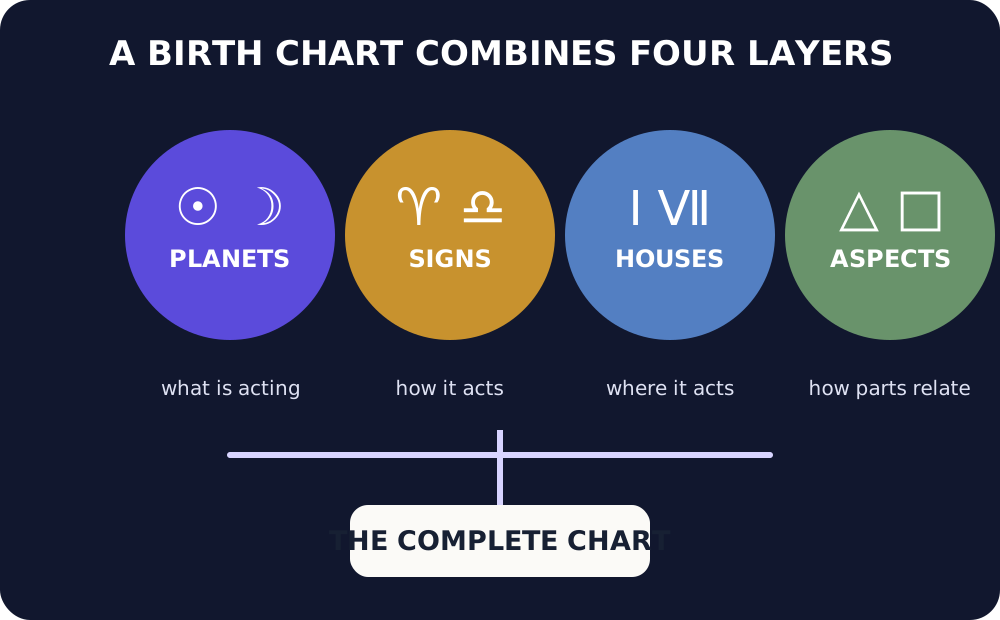
Once the layers are clear, use a repeatable sequence: identify the planet, read its sign, locate its house, then examine major aspects. The step-by-step birth-chart guide walks through that method.
What should a beginner avoid?
- Do not treat a Sun sign as the entire chart. It is one placement.
- Do not treat signs and constellations as identical. They use different boundaries.
- Do not guess a rising sign from personality. It is calculated from time and place.
- Do not equate signs with houses. They are separate layers.
- Do not confuse astrological symbolism with scientific evidence. This site labels the two contexts separately.
Continue learning
Choose the next topic that answers your question.