Birth chart beginner guide
How to Understand a Birth Chart
A birth chart is a map of zodiac positions for a specific time and place. This guide shows what the symbols mean, which parts depend on birth time and a practical order for reading the chart without getting overwhelmed.
What is a birth chart?
A birth chart—also called a natal chart—is a circular representation used in astrology to show the positions of the Sun, Moon and planets in a zodiac framework for a particular date, time and location. Depending on the chart system, it can also show the Ascendant, Midheaven, twelve houses and angular relationships between planets.
The underlying astronomical positions can be calculated. The meanings assigned to those positions are part of astrological tradition and interpretation, not established scientific effects on personality or events.
The four main layers of a birth chart
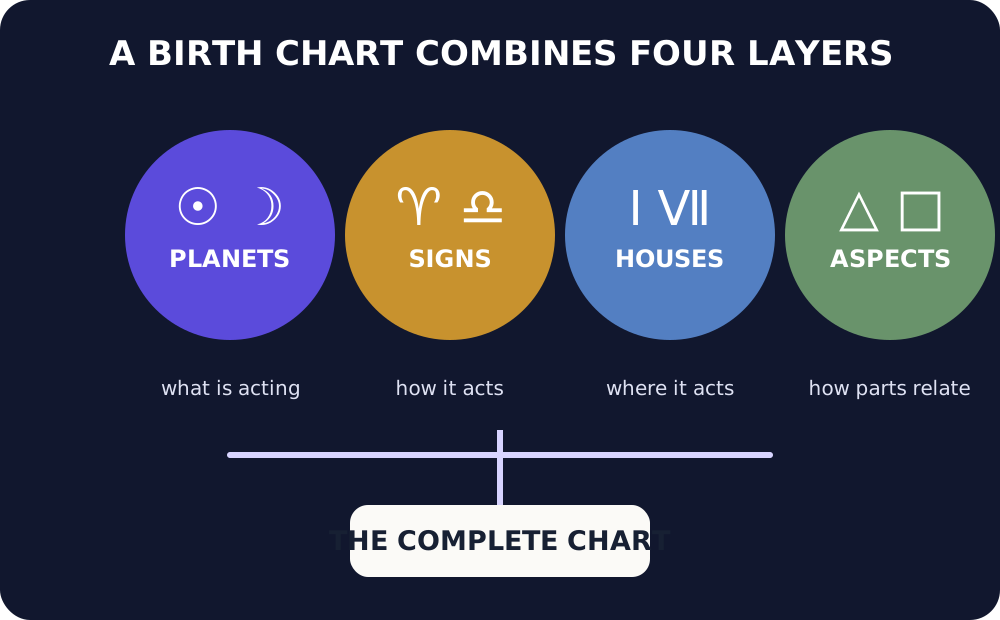
1. Planets: what?
Astrological tradition assigns functions to the Sun, Moon and planets—for example identity, emotion, communication, relating and action.
Learn the planets →2. Signs: how?
The sign is interpreted as the style or mode through which a planet's function operates.
Learn the signs →3. Houses: where?
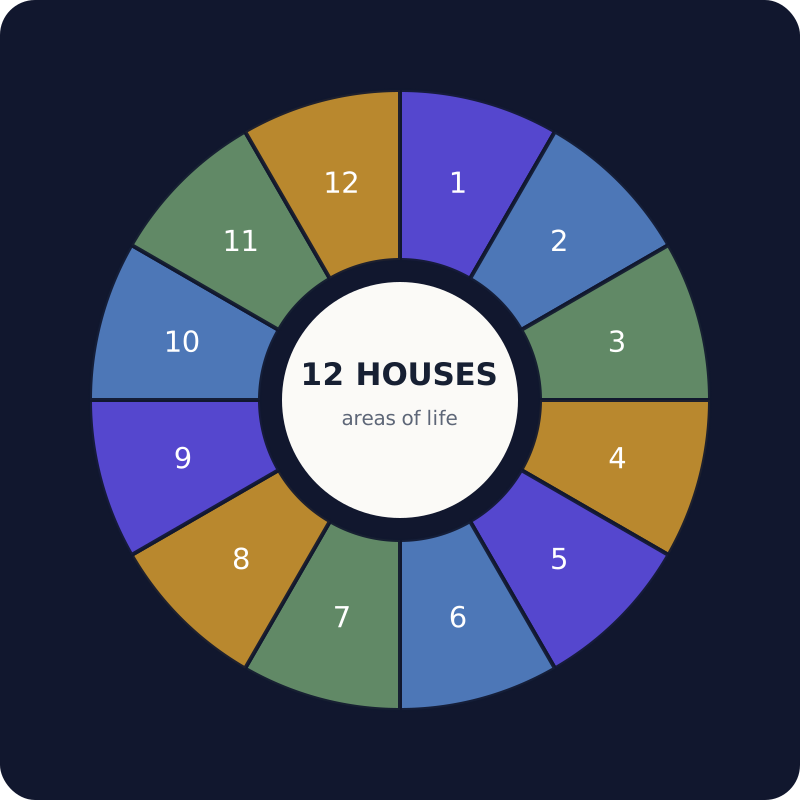
Houses divide the chart into life areas. Their exact cusps usually depend heavily on birth time and location.
Learn the houses →4. Aspects: interaction
Aspects are angular relationships between planets or chart points. They are used to connect placements rather than reading every symbol separately.
Learn aspects →The Big Three: Sun, Moon and Rising sign
| Placement | What it is | Birth-time sensitivity |
|---|---|---|
| Sun sign | The zodiac sign occupied by the Sun. This is the sign most people mean by “my zodiac sign.” | Usually stable across a day, except near a sign transition. |
| Moon sign | The zodiac sign occupied by the Moon, traditionally associated with emotional patterns and instinctive responses. | The Moon moves quickly enough that the sign can change during some birth dates. |
| Rising sign / Ascendant | The zodiac degree rising on the eastern horizon at the birth time and place. | Highly time-sensitive. An accurate birth time is important. |
These three placements are a useful starting point, but they are not a complete chart. See Sun, Moon and Rising for a deeper comparison.
Why birth time and location matter
Your date establishes the broad planetary positions, but local time and location determine how the sky relates to the horizon and meridian. That affects the Ascendant, Midheaven and house cusps. A chart calculated with an invented noon or midnight time can therefore give a misleading rising sign and house structure.
A practical order for reading a birth chart
- Confirm the input. Check date, local birth time, location and time-zone handling.
- Start with the Sun, Moon and Ascendant. These give you an initial orientation.
- Identify the Ascendant ruler. In traditional chart reading, this connects the rising sign to the planet that rules it.
- Review planets by sign. Note the sign occupied by Mercury, Venus, Mars and the other planets.
- Add houses. Only treat them as precise if the birth time is reliable.
- Add major aspects. Look for conjunctions, oppositions, squares, trines and sextiles before minor aspects.
- Look for repetition. Repeated elements, modalities, signs, houses or planetary themes usually matter more to interpretation than one isolated symbol.
- Synthesize. A chart is a system of relationships, not a checklist of independent personality labels.
What the wheel is showing
Most chart wheels place the zodiac around a 360-degree circle. House cusps divide the wheel according to the selected house system, planetary glyphs mark calculated positions, and aspect lines may connect planets across the center. Different astrology software can rotate or style the wheel differently without changing the underlying longitude positions.
Common beginner mistakes
Reading every placement separately
A list of isolated meanings quickly becomes contradictory. Look for repeating patterns and relationships.
Assuming an unknown birth time
An arbitrary time can produce false certainty about the Ascendant, Midheaven and houses.
Treating signs and houses as the same thing
They are separate layers. Aries is not automatically the first house, Taurus is not automatically the second, and so on.
Confusing interpretation with measurement
Planetary positions are calculated from astronomy; astrological meanings assigned to them are interpretive traditions.
Astronomy, calculation and astrological interpretation
A useful birth-chart resource should keep three things separate: the astronomical positions of celestial bodies, the coordinate or house system used to construct the chart, and the astrological interpretation applied afterward. Mixing those categories makes explanations harder to verify.
Birth chart learning path
Continue learning
Explore the topics that interest you next.