Air · Fixed · 300°–330°
Aquarius Zodiac Sign: The Definitive Guide
A complete visual reference to Aquarius dates, fixed-air structure, Saturn and Uranus rulership, water-bearer mythology, constellation astronomy, relationships, work, growth and birth-chart interpretation.
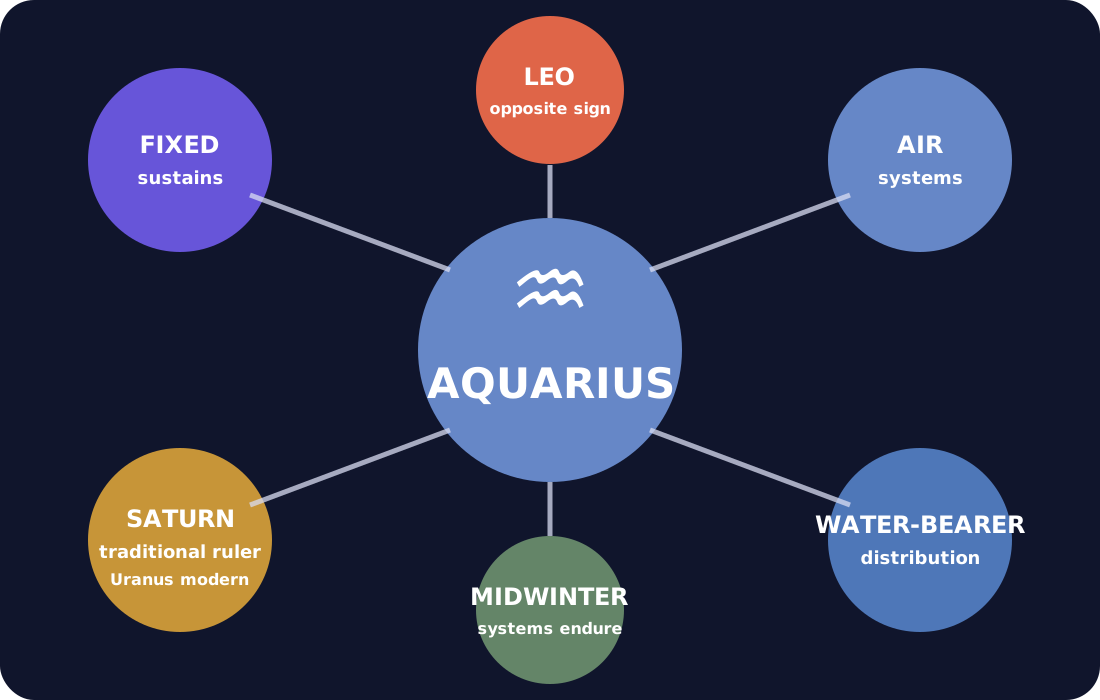
- Aquarius is fixed air: systems and principles combined with persistence.
- Saturn is the traditional ruler; Uranus is the common modern ruler.
- Aquarius stabilizes northern winter in the tropical zodiac.
- Leo is Aquarius’s opposite sign.
- Aquarius is an air sign despite the water-bearer symbol.
Aquarius at a glance
| Standard tropical dates | January 20–February 18 |
|---|---|
| Zodiac position | 300°–330° |
| Element | Air |
| Modality | Fixed |
| Traditional ruler | Saturn |
| Modern ruler | Uranus |
| Symbol | Water-Bearer |
| Opposite sign | Leo |
| Seasonal position | Middle of northern-hemisphere winter |
What Aquarius represents
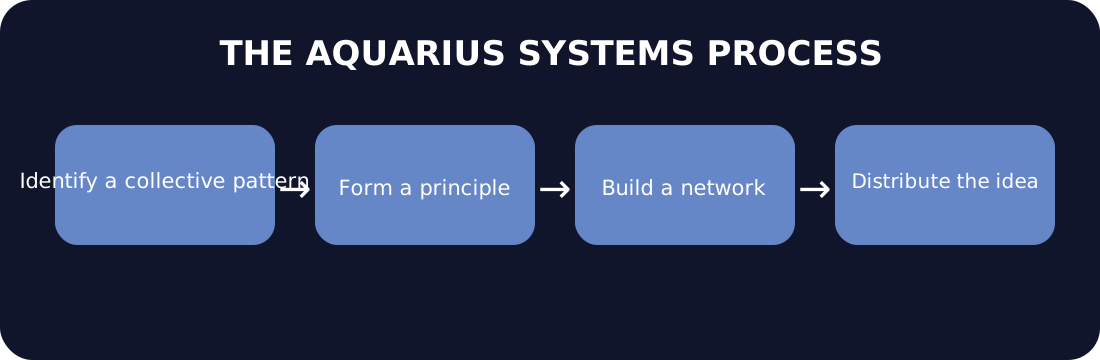
Aquarius represents systems, networks, principles, communities and the distribution of ideas or resources. It follows Capricorn’s institutional structure and asks how a system can serve a wider collective.
The sign is often reduced to rebellion, eccentricity or emotional distance. Those labels miss its fixed structure. Aquarius sustains ideas, social models and principles over time.
An Aquarius placement does not make someone automatically scientific, unconventional or detached. It describes a style through which a planet or chart point may operate.
Midwinter and Aquarius’s place in the cycle
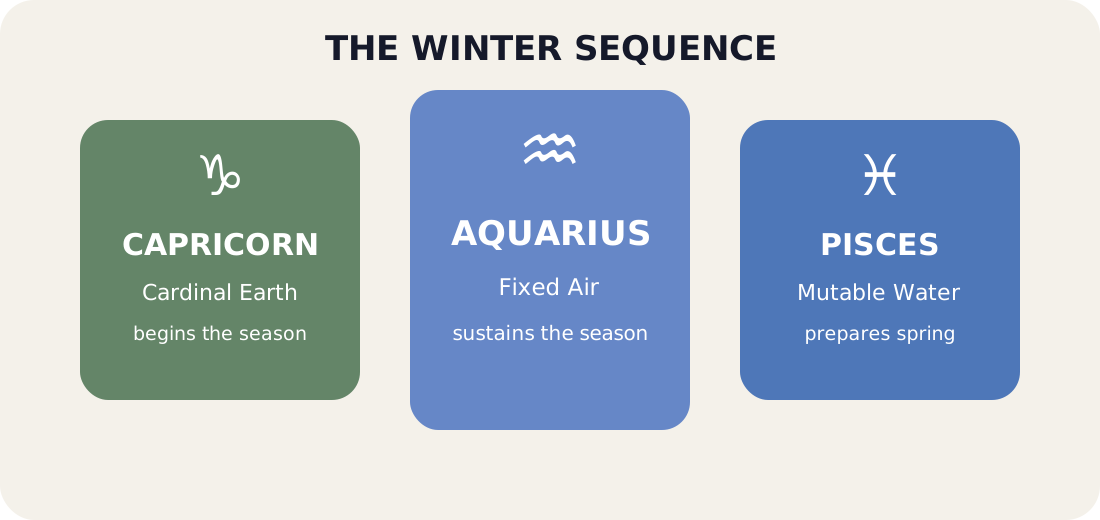
In the tropical zodiac, Aquarius occupies the middle of northern-hemisphere winter. Capricorn initiates the season, Aquarius stabilizes it and Pisces prepares the transition toward spring.
Fixed signs occupy seasonal centers. Aquarius applies that fixed quality to air: principles, systems, networks and collective ideas become more established.
This seasonal framework is symbolic and belongs to tropical astrology. It does not claim that local winter conditions scientifically determine personality.
History, mythology and the water-bearer
Aquarius belongs to an ancient region of the sky filled with water-related figures. Mesopotamian traditions connected the constellation with a divine figure pouring water, often linked with Ea or Enki and the seasonal flow of rivers.
Greek mythology commonly associates Aquarius with Ganymede, a beautiful youth taken to Olympus to become cupbearer to the gods. Other traditions connect the figure with Deucalion and flood stories.
The water-bearer is symbolic rather than elemental. Aquarius is an air sign. The pouring vessel can represent knowledge, life, renewal or resources distributed beyond the individual.
The Aquarius constellation
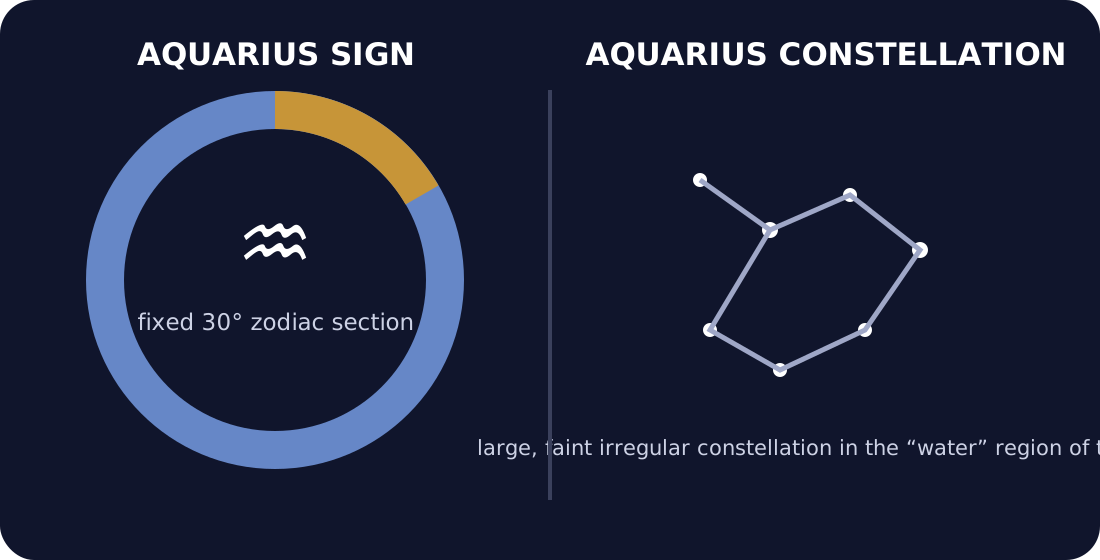
Aquarius the sign is a fixed 30-degree zodiac section. Aquarius the constellation is a large, faint and irregular astronomical sky region.
Aquarius lies near other water-themed constellations, including Pisces, Cetus and Eridanus. Its stars are generally not very bright, which can make the constellation difficult to identify from light-polluted locations.
For Northern Hemisphere observers, Aquarius is generally better placed in autumn evening skies. This differs from tropical Aquarius season in January and February.
The International Astronomical Union defines Aquarius through official boundaries, not by the connecting lines used in popular star charts.
Fixed air, Saturn and Uranus: the Aquarius formula
Air
Air signs are associated with ideas, language, comparison and social exchange. Aquarius air emphasizes systems, networks, abstraction and principles that can apply beyond one person.
Fixed modality
Fixed signs sustain. Aquarius can show consistency, intellectual independence and loyalty to a cause. The same strength can become ideological rigidity or distance from lived experience.
Saturn and Uranus
Saturn is Aquarius’s traditional ruler and symbolizes structure, limits and durable systems. Uranus became its modern ruler after the planet’s discovery and is associated with disruption, invention and independence. Different astrological schools weigh the two rulers differently.
Aquarius personality and traits
Traditional strengths
- Systems thinking
- Originality
- Intellectual independence
- Social awareness
- Consistency of principle
- Network building
Common growth themes
- Emotional presence
- Flexibility
- Listening to lived experience
- Allowing personal needs
- Distinguishing independence from distance
- Testing theory against reality
These are interpretive themes rather than diagnostic conclusions. Aquarius can be expressed through technology, research, community work, engineering, art, organizing, science or any field involving networks and systems.
Communication and decision-making
Aquarius communication is traditionally described as conceptual, objective and oriented toward systems. It may notice patterns that are invisible when a problem is viewed only through individual cases.
This can produce insight and fairness. It can also sound impersonal if theory replaces attention to emotional impact.
Decision-making
Aquarius often evaluates principles, long-term social effects, scalability and independence. A useful practice is testing whether the abstract solution works for the people most affected.
Work, career, leadership and learning
Aquarius is often associated with technology, science, engineering, research, social systems, advocacy, networks and innovation. Career fit depends on ability, opportunity and values—not one sign.
Leadership
Aquarius leadership may focus on decentralization, shared purpose, fair systems and giving capable people room to contribute.
Learning
Aquarius often learns through models, peer exchange, experimentation, unconventional sources and understanding how parts connect.
Workplace challenges
Possible difficulties include rejecting useful tradition, becoming attached to an idealized system or underestimating the need for personal communication.
Love, autonomy and conflict
Aquarius relationship symbolism emphasizes friendship, intellectual connection, autonomy, shared values and respect for individuality.
The challenge is making intimacy personal rather than purely principled. Treating everyone fairly does not replace learning one partner’s specific emotional language.
Conflict
Aquarius may become detached, argumentative or rigidly attached to a principle. Repair improves when ideas are paired with acknowledgment of feelings and practical effects.
Friendship and community
Aquarius is often associated with broad networks, loyalty to groups and acceptance of difference. Friendship may be one of its most important relationship forms.
A useful growth edge is distinguishing community connection from personal closeness. Being available to everyone can sometimes make it difficult to be deeply available to one person.
Parenting and family themes
Aquarius parenting symbolism includes independence, curiosity, fairness, individuality and exposure to diverse ideas.
The challenge is balancing freedom with emotional consistency. Children benefit from being respected as individuals and from knowing that care will remain personally available.
Money, technology and future systems
Aquarius symbolism may connect money with technology, future planning, shared infrastructure, collective ownership or unconventional systems.
Potential difficulties include speculative enthusiasm, detachment from everyday budgeting or assuming a novel model is automatically better. Clear evidence and practical testing matter.
Aquarius under stress and during growth
Under stress, Aquarius can become detached, contrary, isolated or rigidly ideological. It may use independence to avoid vulnerability.
Growth practices
- Ask how a principle affects a real person.
- Share feelings before converting them into analysis.
- Stay open to useful tradition.
- Allow closeness without treating it as loss of autonomy.
- Test innovation in practical stages.
- Update beliefs when outcomes contradict theory.
Aquarius growth is not becoming less independent. It is connecting independence with human presence, accountability and workable systems.
Aquarius in a birth chart
The planet describes the function, Aquarius the style, the house the life area and aspects the interaction.
| Placement | Traditional emphasis |
|---|---|
| Sun in Aquarius | Identity shaped by independence, systems, community and principles. |
| Moon in Aquarius | Emotional regulation through perspective, autonomy and social connection. |
| Aquarius rising | An observant, independent approach; Saturn is traditional chart ruler and Uranus a modern co-ruler. |
| Mercury in Aquarius | Conceptual thinking, originality and systems-level communication. |
| Venus in Aquarius | Affection through friendship, individuality and shared values. |
| Mars in Aquarius | Principled action, invention and energy directed toward groups or causes. |
These are starting points. Houses, aspects and the complete chart can significantly alter interpretation.
The Aquarius–Leo polarity
Aquarius and Leo oppose one another and share the fixed modality. Leo emphasizes personal creative expression, recognition and the heart of an individual. Aquarius emphasizes systems, communities and principles that extend beyond one person.
The axis asks how individuality can contribute to a group without disappearing, and how a collective can function without suppressing personal creativity.
The Age of Aquarius
The “Age of Aquarius” is an astrological concept based on the slow precession of the equinoxes. Because constellation boundaries, zodiac frameworks and starting assumptions differ, astrologers do not agree on when an Aquarian age begins.
Astronomy recognizes axial precession as a measurable motion of Earth. It does not recognize astrological ages as scientifically validated historical forces.
Aquarius myths versus facts
| Myth | More accurate explanation |
|---|---|
| Aquarius is a water sign. | Aquarius is an air sign; the water-bearer is its symbolic figure. |
| All Aquarians are rebels. | Aquarius may challenge systems, but fixed air can also be highly consistent and principled. |
| Aquarius is the Aquarius constellation. | The sign is an equal zodiac section; the constellation is an irregular sky region. |
| Aquarius has no feelings. | Aquarius may process emotion conceptually or privately, but detachment is not absence of feeling. |
| The Age of Aquarius has a confirmed start date. | There is no universal astrological agreement on its timing. |
Astrology and evidence
Zodiac Calendar separates astronomical facts, historical traditions and astrological interpretation. The physical properties of Uranus, Saturn, precession or Aquarius do not scientifically establish the traits associated with the sign.
Frequently asked questions
What dates are Aquarius?
The standard tropical date range is January 20 through February 18. Exact solar ingress times can vary slightly by year and time zone.
What element is Aquarius?
Aquarius is an air sign.
What modality is Aquarius?
Aquarius is a fixed sign.
What planet rules Aquarius?
Saturn is Aquarius’s traditional ruler, while Uranus is widely used as its modern ruler.
What is Aquarius’s symbol?
Aquarius is symbolized by the Water-Bearer.
What sign is opposite Aquarius?
Leo is opposite Aquarius on the zodiac wheel.
What does fixed air mean?
Fixed air symbolizes sustained ideas, principles, networks and systems.
Why is Saturn associated with Aquarius?
Traditional astrology links Saturn with structure, boundaries, institutions and durable systems.
Why is Uranus associated with Aquarius?
Modern astrology links Uranus with disruption, invention, independence and sudden change.
Is Aquarius a water sign?
No. Aquarius is an air sign; the water-bearer is its symbolic figure.
Is Aquarius always rebellious?
No. Aquarius can challenge conventions, but fixed air can also be highly consistent and attached to principles.
Is Aquarius always emotionally detached?
No. Aquarius may process emotion through reflection or systems thinking, but can be deeply loyal and caring.
Sources and further reading
- International Astronomical Union — The Constellations — official constellation boundaries and definitions.
- NASA — Uranus — scientific information about Uranus as a physical planet.
- NASA — Saturn — scientific information about Saturn.
- Zodiac Calendar Source Library — editorial method and references.
- Astrology vs. Astronomy — signs, constellations, precession and evidence boundaries.
Editorial note: Aquarius meanings are presented as historical astrological interpretation, not scientifically proven personality traits.